

Most juicers end up in the back of a cabinet. You use them twice, hate the cleanup, and move on.
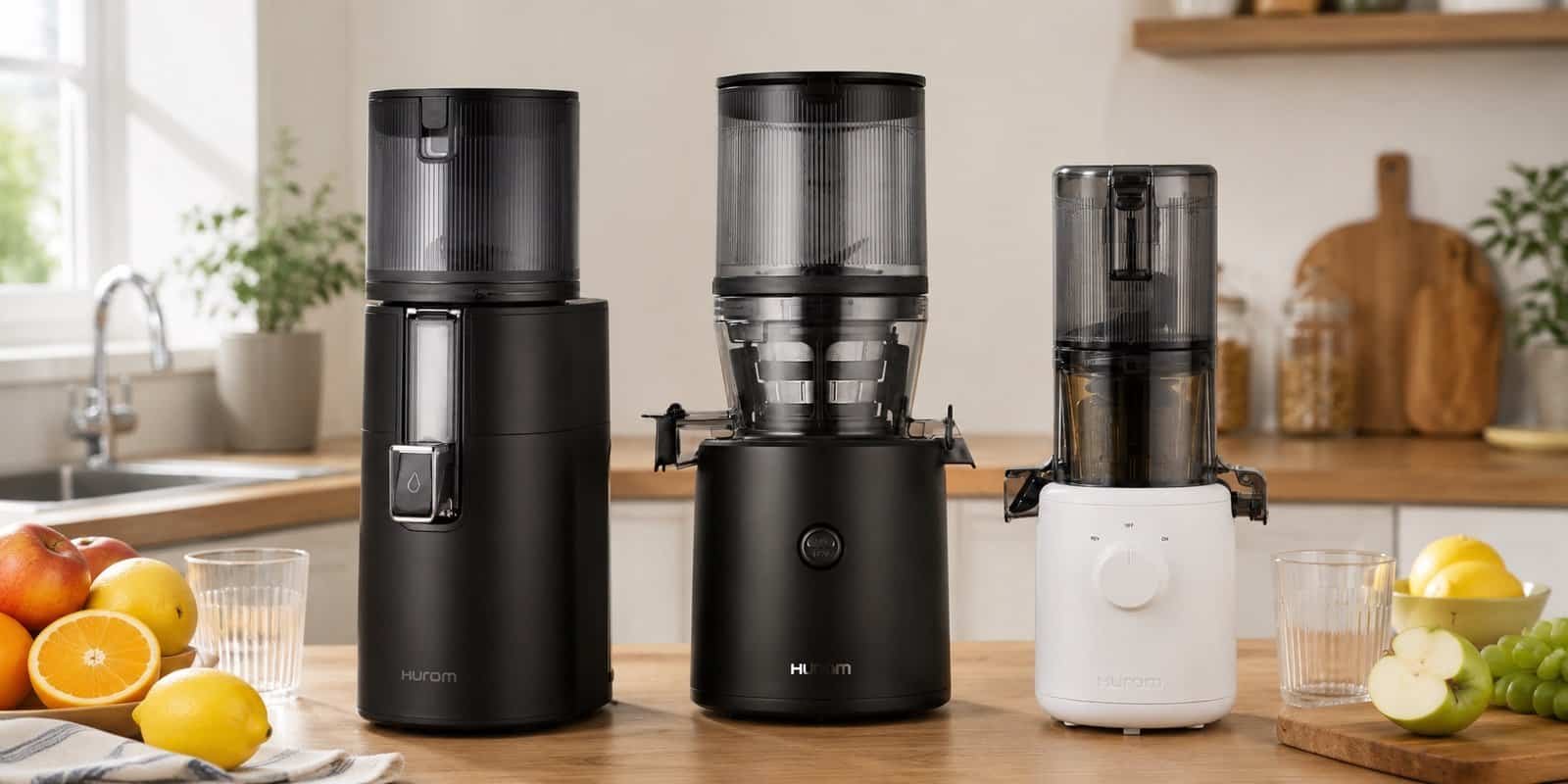
That is the real problem Hurom set out to solve. The South Korean brand invented slow juicing in 1974. Their current lineup promises quick cleanup, less noise, and better-tasting juice. We ran a 30-day Hurom juicer review across three models to find out if the claims hold up.
We tested the H400, H310, and H320 daily – kale, beets, carrots, celery, frozen fruit, all of it. Two models earned a permanent spot on the counter. One is worth knowing about for a specific reason. The breakdown is below.
What Is Hurom?
Hurom has been building slow juicers since 1974. They invented the vertical cold press juicer category and still hold key patents on the technology. Before Hurom, every home juicer used fast-spinning blades – that method creates heat, and heat breaks down enzymes and nutrients.
Hurom’s Slow Squeeze Technology works differently. The auger spins at 43 to 100 RPM depending on the model, pressing produce like a hand squeezing a lemon. No heat buildup. Less oxidation. Measurably fresher juice.
Their lineup breaks into two groups. The Easy Clean Series – H400, H310, H70 – uses a strainer-free chamber that rinses under water in under 60 seconds. The Classic Series – H320, H320N – uses a fine mesh strainer for ultra-smooth, low-pulp juice. Hurom also manufactures cold press units for Omega and Nama, which says a lot about where they sit in the market.
Hurom Juicers We Tested: Full Cold Press Breakdown
Hurom H400 – Best for Families and Batch Juicing
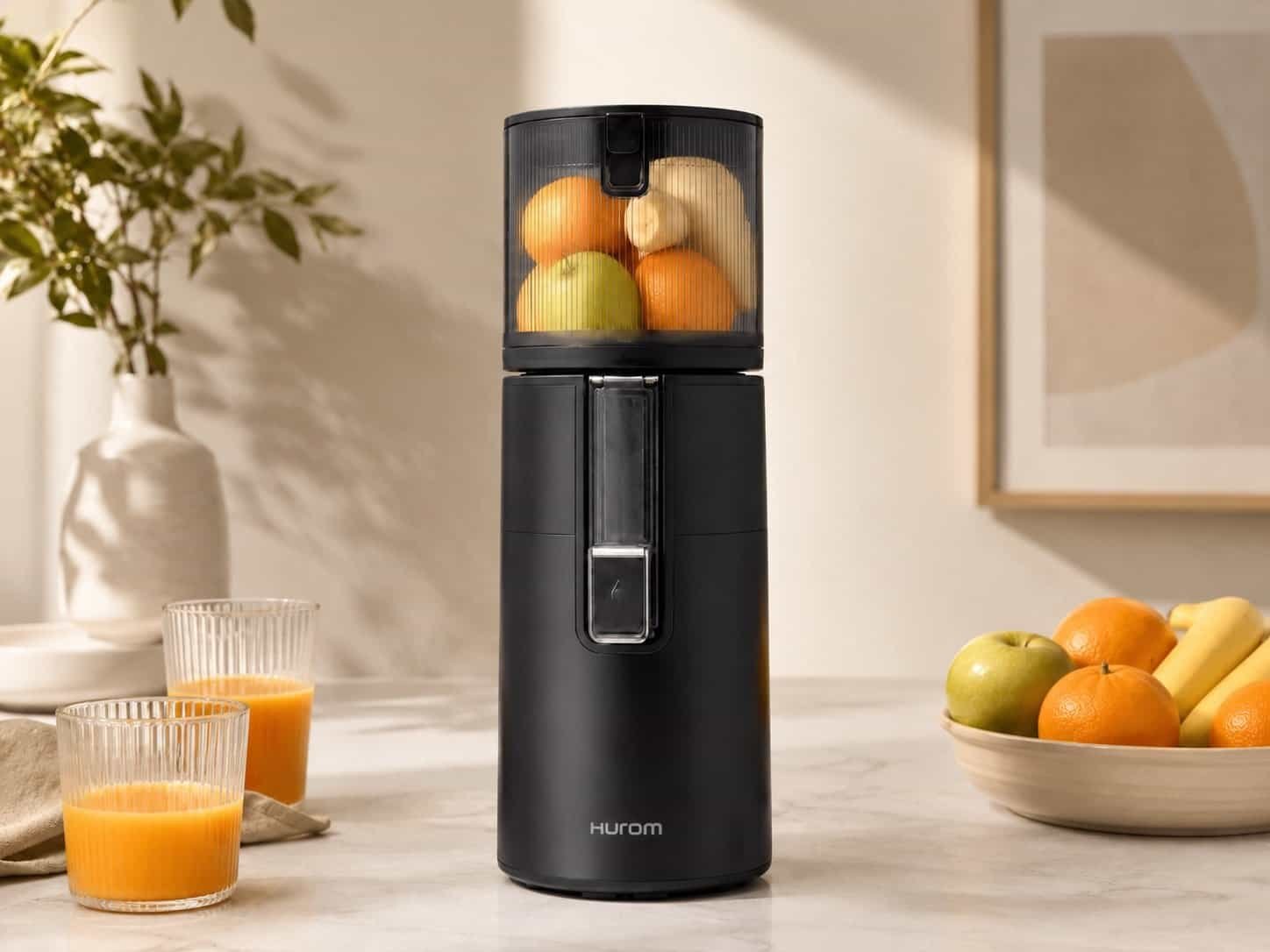
The H400 is the largest model in Hurom’s Easy Clean lineup – about 18 inches tall, available in matte white and matte black. The self-feeding hopper fits a whole apple, and a built-in chopper handles larger pieces automatically.
At 90 RPM it’s the fastest cold press juicer Hurom makes. We ran it daily for two weeks: green juice, carrot-ginger, beet-apple, celery, batch prep for three days at a time. Hard produce dropped in with zero prep. Carrots, apples, cucumber – straight into the hopper. Juice clarity was clean and noticeably low-pulp. Cleanup took 45 to 60 seconds.
Two honest limitations. First, celery juice came out slightly browned – at 90 RPM the faster speed creates slightly more oxidation than slower models. A real issue if celery juice is your main use case. Second, pulp occasionally catches near the chamber exit and needs one extra wipe, which breaks the under-one-minute clean promise occasionally.
Counter footprint is large. Measure before buying if your kitchen is tight.
Price: $669 | Check the Hurom H400 price and options at hurom.com
Hurom H310 – Best Compact Slow Juicer for Solo Use
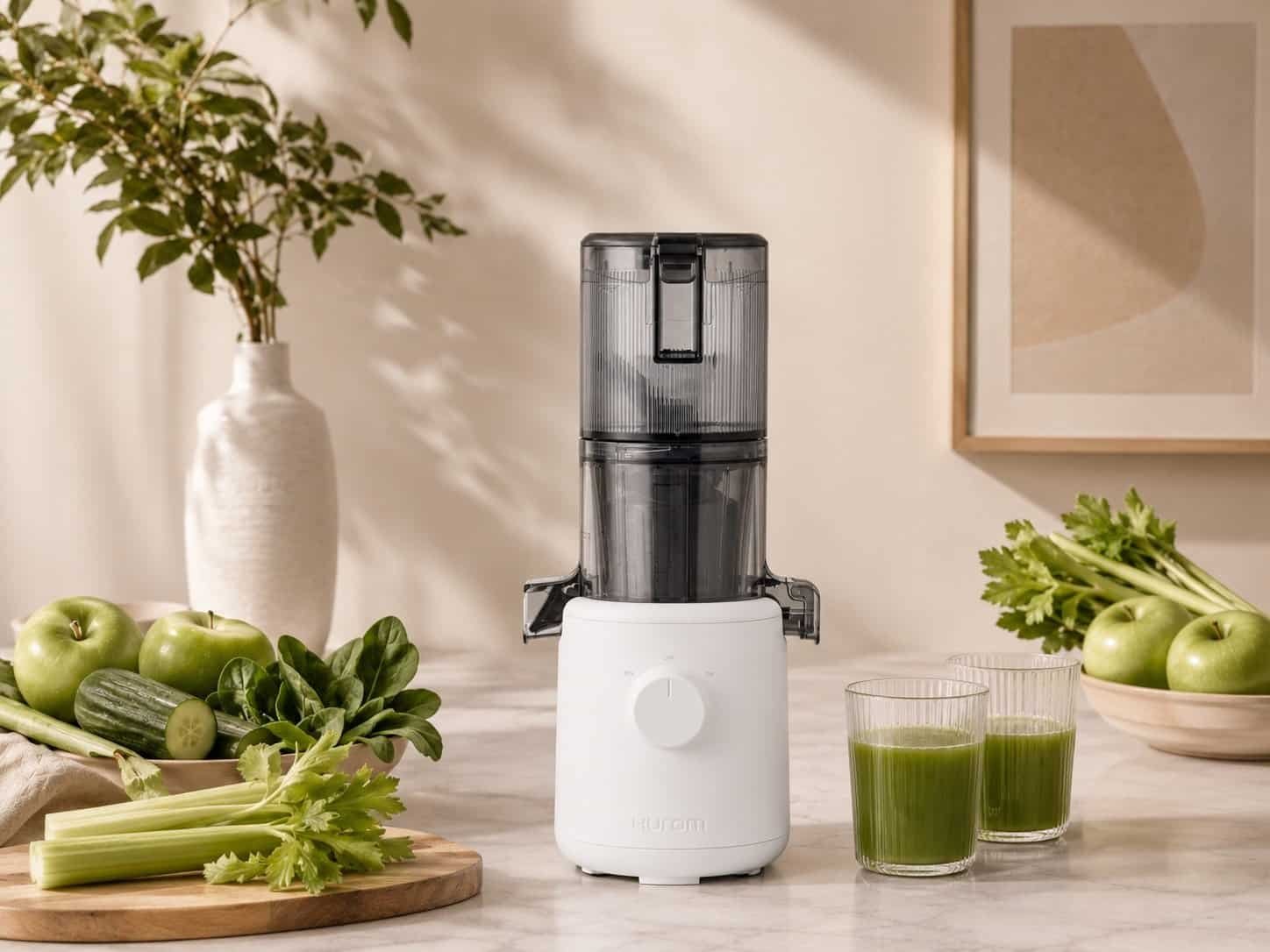
The H310 weighs under 8 pounds and takes up less space than most coffee makers. Five color options – Lavender, Sky Blue, Charcoal, Beige, White. It travels well and fits in small kitchens without compromise.
Despite the size, it runs the same Slow Squeeze Technology as larger models at 45 RPM – the slowest in the lineup, meaning the least oxidation of any Hurom we tested. We used it as a daily single-serve juicer for two weeks. Drop ingredients in, turn it on, juice into your own glass. Parts rinsed clean in under a minute. The juice was rich and noticeably low-foam. Near-silent.
Four honest limitations: the hopper is smaller than the H400, harder items like whole beets still need trimming, juice is slightly pulpier than mesh-strainer models, turmeric and beet stain the plastic chamber over time, and juice directly into your own glass or provided container.
Price: $429 | View the Hurom H310 in all available colors at hurom.com
Hurom H320 – Best for Smooth, Low-Pulp Cold Press Juice
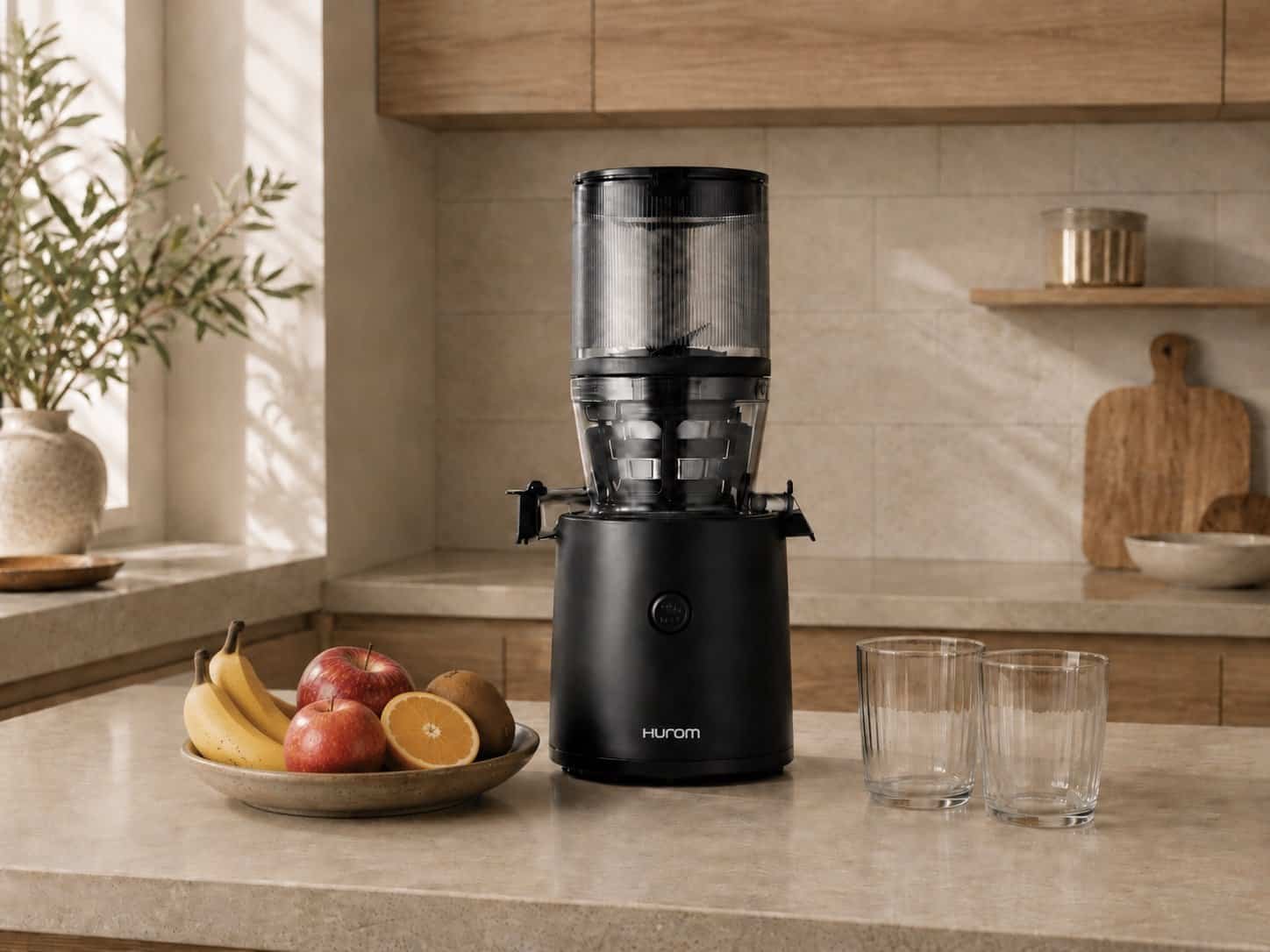
The H320 uses a traditional mesh strainer – harder to clean than Easy Clean models, but the best slow juicer in the lineup for pure juice clarity. We tested it on celery, leafy kale, and soft stone fruit. All three came out clean. Pulp was bone-dry. High juice yield.
If you want juice that looks and tastes like premium store-bought cold press, the H320 delivers it better than the other models we tested. The coarse strainer attachment also makes smoothies directly in the chamber.
The catch is cleanup. The mesh strainer collects pulp and mineral buildup – budget 3 to 5 minutes and a brush. If that’s a dealbreaker, the H400 is the smarter buy.
Price: $599 | View the Hurom H320 Slow Juicer at hurom.com
Pros and Cons
Pros
- Slow Squeeze Technology preserves more nutrients than centrifugal juicers – measurably fresher juice
- Easy Clean models rinse in under 60 seconds – no scrubbing, no soaking
- Near-silent 150W motor – safe to run at 6am without waking anyone
- 100% BPA-free parts made from Ultem and Tritan aerospace-grade materials
- 15-year motor and parts warranty on H400 and H320; H310 comes with 10-year motor and 2-year parts warranty – best in category
- Forbes named the H400 the best cold press juicer in 2024 – after 30 days of testing, that still holds
Cons
- Premium price – entry models start at $449, flagships go past $549
- Slower than centrifugal machines – not built for speed
- Turmeric and beet stain the plastic chamber over time
- No juice container included with some models
Who Should Buy a Hurom Juicer?
Hurom juicers are built for daily use. If you juice three or more times a week, the investment pays off fast. The Easy Clean models specifically remove the friction that kills most people’s juicing habits – slow cleanup is the number one reason people quit.
Families prepping juice for multiple people will get the most from the H400. The oversized hopper and batch-friendly size handle volume without slowing down. Health-focused users who care about nutrient retention will notice a real difference – cold press at this quality level produces measurably fresher, fuller-flavored juice than anything centrifugal.
Skip Hurom if your budget is under $200, you need juice fast, counter space is very tight, or you juice occasionally – daily use is where the price makes sense.
Not sure if slow juicing is right for you at all? We compared the Hurom H400 directly against a centrifugal machine – cold press vs centrifugal, broken down category by category.
Final Verdict
Buy the H400 if you juice for a family or want the easiest daily routine possible. It cleans in under a minute, handles whole produce without prep, and runs quietly enough for early mornings without waking anyone up. The self-feeding hopper is genuinely one of those features you don’t appreciate until you’ve used a juicer that doesn’t have one. Forbes called it the best cold press juicer in 2024 – after 30 days of daily testing across kale, beets, celery, apples, and frozen fruit, that verdict still holds.
Live alone or have a smaller kitchen? Start with the H310. At $449 it costs $220 less than the H400, takes up roughly half the counter space, and cleans just as fast. The 45 RPM motor actually produces slightly less oxidation than the faster H400 – meaning the juice stays fresher longer in the fridge. The slightly pulpier texture is a minor trade-off most people stop noticing after a week. And if you ever move to a bigger kitchen or start juicing for two, the H400 will still be there.
The H320 is for people who already know exactly what they want: the smoothest, lowest-pulp cold press juice possible. The mesh strainer extracts every last drop and leaves nothing behind. It delivers that better than any other model in the lineup – just budget a few extra minutes for cleanup compared to the Easy Clean series. If juice clarity is your benchmark for quality, the H320 is the right call.
All three share the same core: Hurom’s patented Slow Squeeze Technology, 100% BPA-free materials, and a near-silent motor that won’t turn your kitchen into a construction site at 7am. Hurom invented this category in 1974. Five decades later, they still make the best machines in it. The 15-year warranty on the H400 and H320 isn’t a marketing line – it’s a statement about how long these machines are built to last.
Browse the full Hurom slow juicer lineup at hurom.com
FAQ
Is Hurom worth the price compared to cheaper juicers?
Yes, for regular juicers. The 15-year warranty, faster cleanup, and better juice quality make the cost reasonable over time. Budget models often get abandoned because cleanup is too slow – Hurom solves that problem directly with the Easy Clean series.
How long does a Hurom juicer take to clean?
Easy Clean models (H400, H310) clean in under 60 seconds – rinse the parts under running water and done. The H320 Classic takes 3 to 5 minutes because the mesh strainer requires a brush.
Can Hurom cold press juicers make nut milk?
Yes. Most Hurom models process almonds, oats, and cashews into plant-based milk. Some include a coarse strainer specifically for this. It’s one of the more useful and overlooked features of the lineup.
Are Hurom juicer parts BPA-free?
All Hurom models use 100% BPA-free materials including Ultem and Tritan. No blades, no sharp parts. Safe for everyday family use across the full product range.
Which Hurom model is best for one person?
The H310. Compact, quiet, self-feeding, and fast to clean. Built for one to two servings. For batch juicing or families, the H400 is the better choice.


