

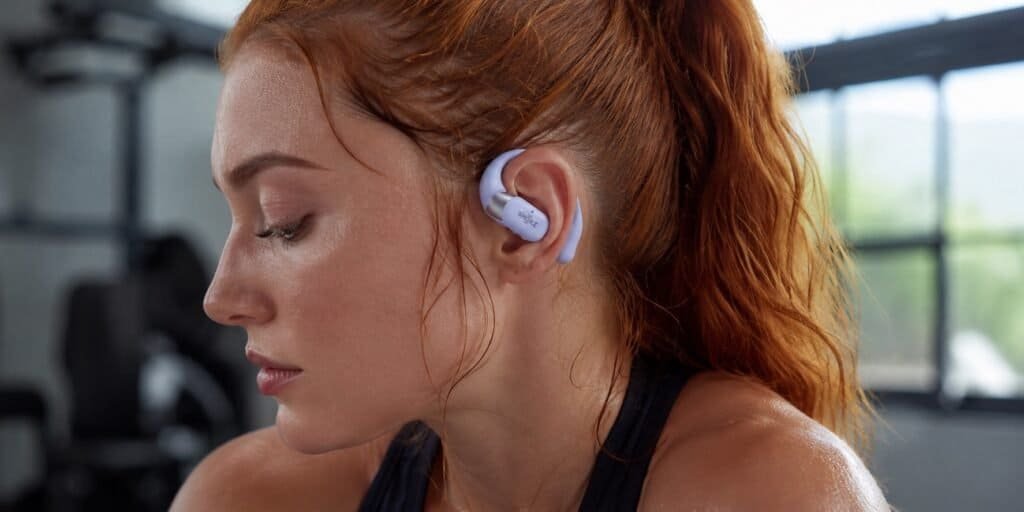
Shokz has become almost synonymous with headphones that leave your ears open. That sounds like one simple product idea, but the current lineup actually covers three very different jobs: secure bone-conduction headphones for running, open earbuds that prioritize sound and all-day comfort, and waterproof headphones that can play music while you swim.
That distinction matters because buying the wrong Shokz model is easy. OpenRun Pro 2 is brilliant for a road run but unnecessary for someone who mainly wants podcasts at a desk. OpenFit 2+ sounds fuller and works better as an everyday earbud, but it is not designed for swimming. OpenSwim Pro can go into the pool, yet its underwater music workflow is completely different from normal Bluetooth listening.
For this Shokz review, we narrowed the brand down to three models that represent its most useful categories. We compared current US specifications, pricing, battery life, water resistance, independent testing, and the practical compromises of open-ear audio. We have not treated a longer feature list as automatically better – each model needs to make sense for a real type of user.
If headphones are only one part of your training setup, our Top Wellness Tech 2026 guide covers recovery and health devices that solve a different part of the fitness-tech puzzle.
Quick Picks
| Model | Best For | Price | Battery | Main Trade-Off |
| OpenRun Pro 2 | Running and outdoor training | $179.95 | Up to 12 hours | Open design loses impact in loud environments |
| OpenFit 2+ | Everyday use and better sound | $199.95 | 11 hours / 48 with case | Less secure than a wraparound band for some sports |
| OpenSwim Pro | Swimming and triathlon | $229.95 | 9h Bluetooth / 6h MP3 | Bluetooth does not work underwater |
What Is Shokz?
Shokz specializes in open-ear audio. Instead of sealing music inside the ear canal like conventional earbuds, its headphones are designed to leave the ear open so outside sounds can still reach you naturally. That is why the brand became especially popular with runners, cyclists, walkers, and people who dislike the pressure of in-ear silicone tips.
The important thing to understand is that not every Shokz product uses bone conduction. The OpenRun and OpenSwim families do. OpenFit models use small air-conduction speakers positioned just outside the ear canal. Both designs leave your ears open, but they feel and sound different.
Bone Conduction vs Open-Ear Earbuds: What Changes in Real Life?
Bone-conduction headphones rest against the area in front of your ears and send vibrations through the skull toward the inner ear. Your ear canal stays physically open. Open-ear earbuds such as OpenFit 2+ work more like tiny directional speakers that sit near the ear without plugging it.
Houston Methodist’s audiologist guide to headphone types describes bone conduction as particularly useful for people such as runners and cyclists who need to remain aware of their surroundings. That is the practical reason to buy Shokz – not because the technology makes music magically safer, but because it does not physically block your ears.
The sound trade-off is real. Traditional in-ear earbuds create a seal, which makes deep bass easier and blocks competing noise. Open designs deliberately give up that seal. In a quiet park or home office, that can be a great compromise. Next to traffic, on a train, or inside a loud gym, you may turn the volume higher just to hear a podcast clearly.
That also means open-ear does not equal hearing protection. Volume and listening time still matter. If you regularly train in very noisy places, noise-cancelling earbuds used at a sensible volume may actually require less volume than an open design fighting the same background sound.
Shokz Review: The 3 Models Worth Considering
Shokz sells cheaper and more specialized options, but these three models make the buying decision easiest because each has a distinct purpose. If you know where you will use the headphones most often, the choice is straightforward.
1. Shokz OpenRun Pro 2 – Best for Running and Outdoor Training
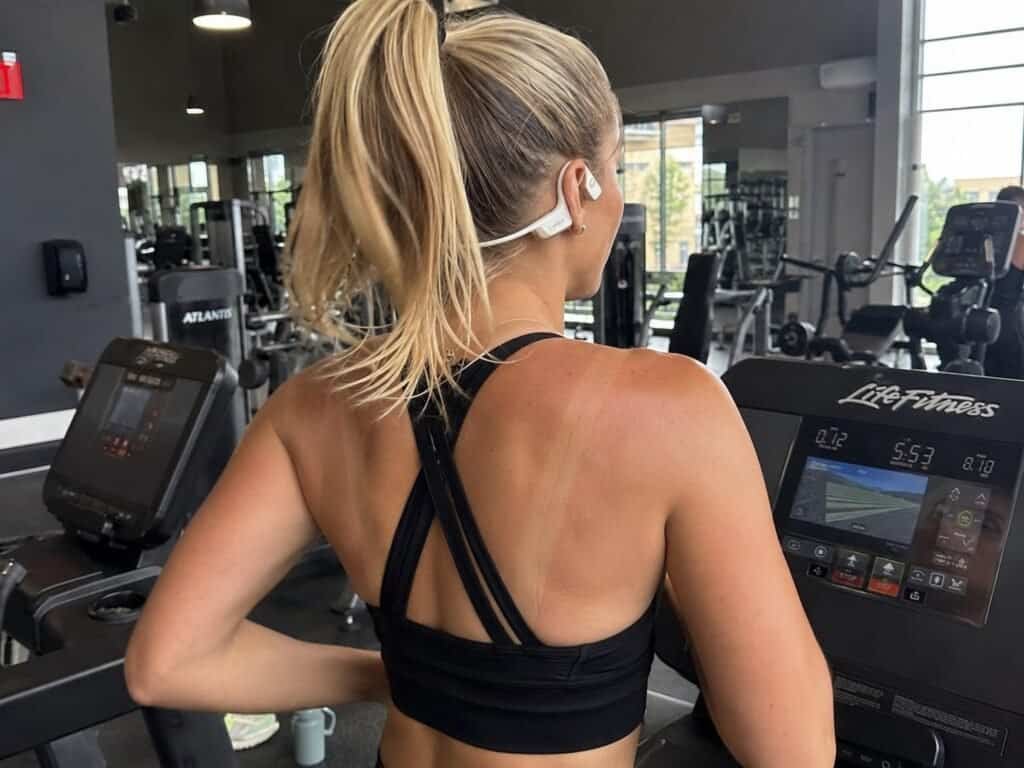
OpenRun Pro 2 is the model most people picture when they hear the Shokz name. A flexible titanium band wraps behind the head, with the transducers sitting in front of the ears rather than inside them. At 30.3 grams, it is light enough to disappear during a long run, while the wraparound shape is much harder to shake loose than two independent earbuds.
The biggest technical change over older Shokz running headphones is DualPitch. OpenRun Pro 2 uses bone conduction for mids and highs, then adds a separate air-conduction driver for bass. In plain English, Shokz is no longer asking bone conduction to do everything. That matters because bass has traditionally been the weak point of this category, and the dedicated low-frequency driver gives music more body without increasing the vibration against your cheekbones as much.
It still does not sound like a sealed pair of premium earbuds. Bass is less physical, and busy roads can mask quieter parts of a podcast. But for a running headphone, sound quality is only half the job. The other half is staying in place, surviving sweat, and letting you hear a bicycle bell, another runner, or approaching traffic.
Battery life is rated at up to 12 hours and a full charge takes about one hour. USB-C is another practical improvement over older proprietary charging connectors. The IP55 rating handles sweat and light rain, but this is not a swimming headphone and should not be treated as one.
Independent testing from RTINGS also rates OpenRun Pro 2 well for sports and fitness, particularly for its stable open fit. That lines up with the product’s strongest use case: it is not the Shokz with the richest sound, but it is the one we would choose for running outdoors.
Best for: road runners, trail runners, walkers, cyclists who use headphones where permitted, and anyone who values a secure fit more than maximum bass.
Potential drawback: the open design is easy to overpower with traffic, wind, or loud gym music, and the IP55 rating is sweat-resistant rather than waterproof for swimming.
2. Shokz OpenFit 2+ – Best for Everyday Use and Better Sound
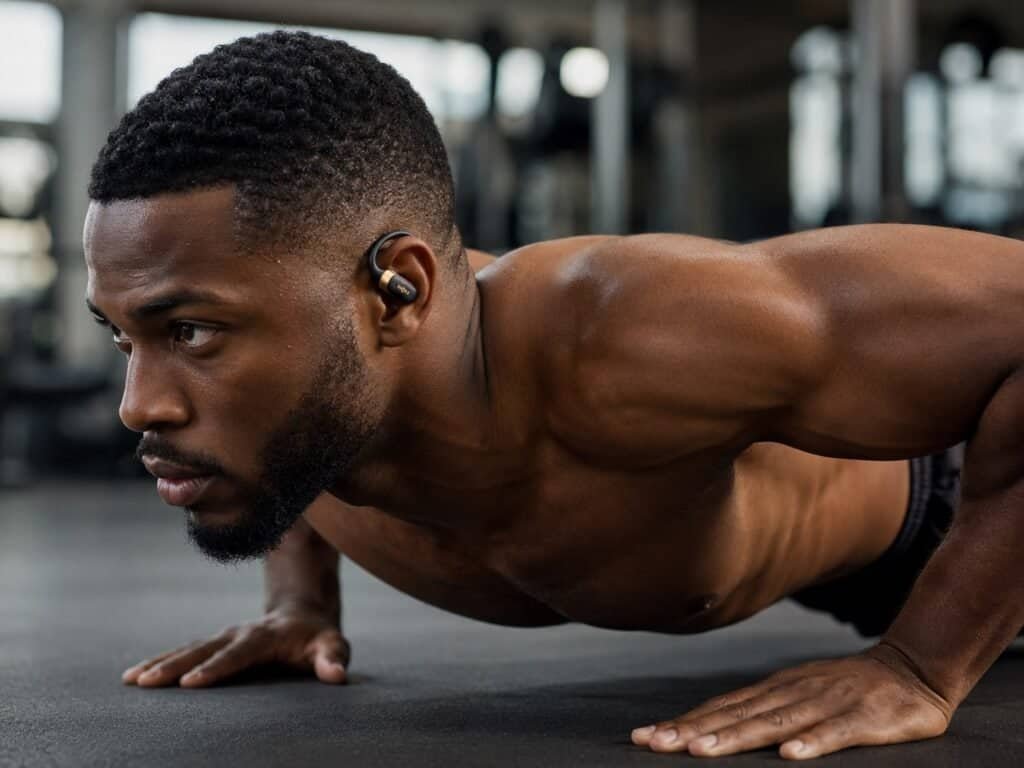
OpenFit 2+ is for the person who likes the idea of open ears but does not necessarily want bone conduction. Each earbud hooks around the ear and positions its speaker near the ear canal. There is no neckband connecting the two sides, so they look and behave more like normal wireless earbuds.
That design gives OpenFit 2+ a noticeable advantage in everyday sound. Shokz uses separate high- and low-frequency drivers through its DualBoost system, plus Dolby Audio. The result is fuller bass and cleaner detail than traditional bone-conduction headphones can usually manage. It still will not isolate you from a train carriage or airplane cabin, but music sounds less compromised in quiet and moderately noisy environments.
Each earbud weighs about 9.4 grams. The flexible ear hooks distribute the weight around the ear rather than pressing into the canal, which can be a major comfort advantage for people who dislike silicone tips. Physical multifunction buttons are also easier to use during exercise than touch-only controls, especially with sweaty hands.
Battery life reaches up to 11 hours from the earbuds and up to 48 hours with the case. The 2+ version adds two upgrades over OpenFit 2: Dolby Audio and wireless charging. If neither matters to you, the regular OpenFit 2 at $179.95 is the more rational value pick because the basic fit, battery system, and open-ear concept are very similar.
IP55 resistance is enough for sweat and light rain, but these are not waterproof swim earbuds. They are also more exposed to environmental noise than sealed earbuds, and Dolby Audio can reduce battery life by roughly two hours when enabled.
Best for: gym sessions, walking, office calls, podcasts around the house, and people who want one open-ear pair for both exercise and everyday life.
Potential drawback: you pay more for better sound and everyday convenience, but the independent-earbud design may not feel as locked-in as OpenRun Pro 2 during hard running or very dynamic workouts.
3. Shokz OpenSwim Pro – Best for Swimming and Triathlon
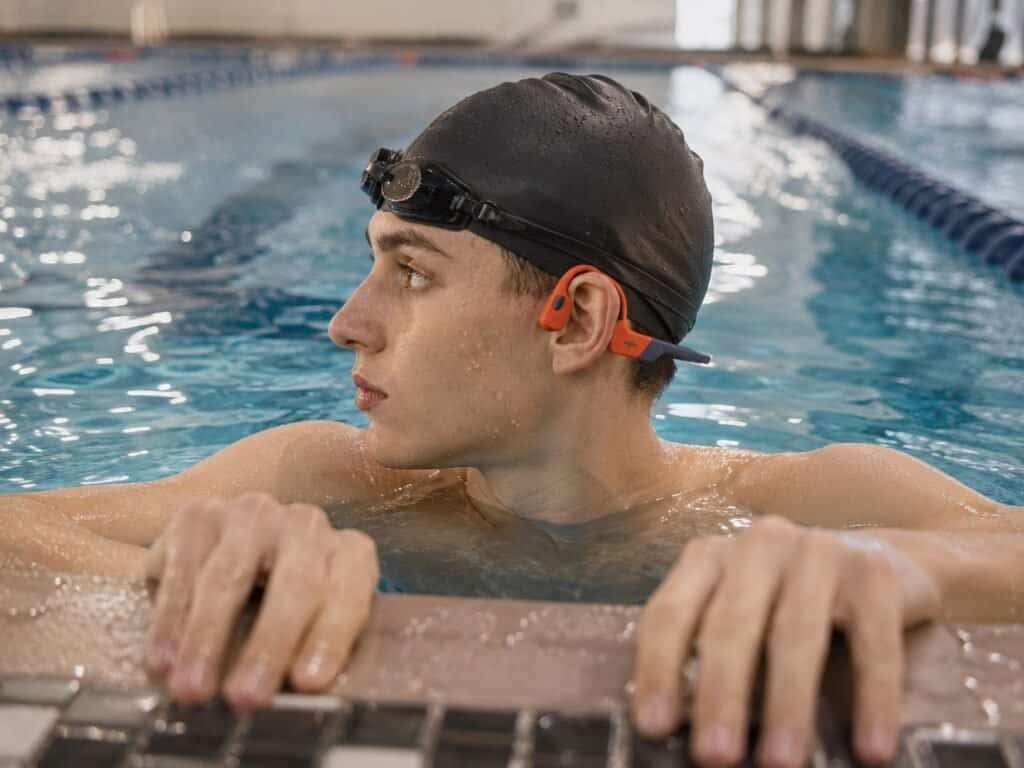
OpenSwim Pro solves a problem that normal Bluetooth earbuds simply cannot: streaming audio does not travel reliably through water. Instead of pretending Bluetooth will work underwater, Shokz gives the headphones 32GB of internal storage and an MP3 mode for swimming.
On land, OpenSwim Pro behaves like a normal Bluetooth 5.4 headset. Underwater, you switch to the stored music library. Shokz says 32GB can hold roughly 8,000 regular-quality songs, depending on file size. The headphones support common formats including MP3, FLAC, WAV, AAC, M4A, APE, and WMA.
That workflow sounds old-fashioned if you are used to Spotify, but it is the practical reality of underwater audio. You transfer music files to the headphones before the session, then leave the phone in your locker. For lap swimmers, that is far better than trying to maintain a wireless connection that physics will not cooperate with.
The IP68 rating is the key specification here. OpenSwim Pro is designed for continuous immersion and Shokz specifies use down to two meters. Battery life reaches up to nine hours in Bluetooth mode and six hours in MP3 mode. At 27.3 grams, it is also slightly lighter than OpenRun Pro 2.
There are limitations. Bluetooth does not function underwater, there is no streaming-service download system built into the device, and Shokz does not recommend it for diving. Salt-water use also requires more care; after exposure, the brand advises soaking the headphones in fresh water to remove salt.
Best for: lap swimmers, triathletes, pool training, paddleboarding, and people who want one waterproof headset that also works over Bluetooth on land.
Potential drawback: loading local music files is less convenient than opening a streaming app, and the $229.95 price only makes sense if swimming is a regular part of your routine.
Pros and Cons
Pros
- Open-ear designs let you hear more of what is happening around you.
- Secure options for running, gym training, and swimming.
- No silicone tip sealing the ear canal, which many people find more comfortable for long wear.
- Battery life is strong across the three main models.
- The lineup has genuinely different products instead of small cosmetic variations.
- OpenSwim Pro provides a practical solution for underwater audio.
Cons
- Open designs cannot match sealed earbuds for bass impact or noise isolation.
- Podcasts and quieter music can be difficult to hear beside heavy traffic or in a loud gym.
- OpenRun Pro 2 costs premium-earbud money without ANC or a charging case.
- OpenFit 2+ is sweat-resistant but not suitable for swimming.
- OpenSwim Pro requires local music files underwater because Bluetooth cannot work through water.
- Leaving your ears open does not remove the need to keep volume at a sensible level.
Which Shokz Should You Buy?
The easiest way to choose is to ignore most of the specifications and ask where the headphones will spend the most time.
Choose OpenRun Pro 2 if you run outside
The wraparound fit is the most secure, the 12-hour battery is more than enough for long training days, and the open design makes sense when environmental awareness is part of the reason you are buying the headphones. It is the best Shokz model for running even though OpenFit 2+ sounds better.
Choose OpenFit 2+ if you want one pair for the whole day
This is the best option for someone moving between a walk, gym session, desk, and phone calls. The sound is fuller, the case extends total battery life to 48 hours, and there is no band behind the head. If Dolby Audio and wireless charging do not matter, save $20 and buy OpenFit 2 instead.
Choose OpenSwim Pro if swimming is non-negotiable
There is no reason to pay $229.95 for OpenSwim Pro if you never enter a pool. But for regular swimmers, the waterproof build and internal storage solve a problem the other models simply cannot solve.
If most of your exercise happens outdoors rather than in a pool or gym, our Best Outdoor Tech Gadgets for Summer 2026 guide covers other gear that earns its place on a walk, hike, campsite, or day outside.
Are Shokz Better Than Regular Earbuds for Running?
For awareness, yes. Because the ear canal remains open, you can hear more ambient sound without relying on an electronic transparency mode. That is useful when you want music in the background rather than complete isolation from the environment.
But ‘better for running’ depends on where you run. On a quiet trail or residential route, the Shokz approach works extremely well. Next to constant road noise, open headphones can become frustrating because the environment competes directly with your music. Raising the volume to compensate defeats part of the point.
They also do not make road running automatically safe. You still need to pay attention, follow local rules, and keep the volume low enough that outside sounds remain useful. For cyclists, headphone laws vary by location, so the open design should not be treated as permission to ride with headphones everywhere.
How Good Is Shokz Sound Quality?
Shokz sounds much better than the ‘voice through your skull’ stereotype suggests, but the answer depends on the model. OpenFit 2+ is the strongest choice for music because it uses conventional air-conduction speakers positioned outside the ear. OpenRun Pro 2 improves bone-conduction sound by adding a separate air-conduction bass driver. OpenSwim Pro prioritizes waterproofing and practicality over hi-fi performance.
The consistent compromise across all three is isolation. You hear the room, street, or gym because that is what the products are designed to allow. If your priority is deep bass, airplane use, commuting on a noisy subway, or blocking office chatter, a good pair of ANC earbuds will make more sense.
For spoken audio, running playlists, calls, and background music, the trade-off can be worthwhile. The question is not whether Shokz beats premium sealed earbuds in a quiet sound-quality test. It usually will not. The question is whether slightly less immersive sound is worth keeping your ears physically open.
Final Verdict
Shokz is worth considering because the company is not simply selling a strange alternative to normal earbuds. Its best products solve specific problems that sealed earbuds handle poorly: staying aware on an outdoor run, wearing audio for hours without blocking the ear canal, and listening to music underwater.
OpenRun Pro 2 is the best choice for runners and outdoor training. The secure titanium band, 12-hour battery, USB-C charging, and hybrid DualPitch sound system make it the most complete sports-focused Shokz model for dry land.
OpenFit 2+ is the better everyday headphone. It sounds fuller, works well for calls and gym sessions, and feels closer to a conventional premium earbud without sealing the ear. The regular OpenFit 2 is the smarter value if you do not care about Dolby Audio or wireless charging.
OpenSwim Pro is the specialist. Its IP68 waterproofing and 32GB internal storage make sense for swimmers in a way that no amount of extra battery life or better bass can replace.
The wrong reason to buy Shokz is expecting the best sound for the money. The right reason is wanting audio that fits around what you are doing instead of shutting the rest of the world out.
FAQ
Are Shokz actually bone-conduction headphones?
Some are. OpenRun Pro 2 and OpenSwim Pro use bone-conduction technology. OpenFit 2+ is an open-ear air-conduction earbud that uses speakers positioned near, rather than inside, the ear canal.
Which Shokz headphones are best for running?
OpenRun Pro 2 is the best choice for most runners because the wraparound band is secure, the battery lasts up to 12 hours, and the open design leaves the ear canal unobstructed.
Can you swim with Shokz OpenRun Pro 2?
No. OpenRun Pro 2 is IP55-rated for sweat and light rain, not swimming. OpenSwim Pro is the Shokz model designed for pool use and carries an IP68 rating.
Does Bluetooth work underwater with OpenSwim Pro?
No. Water disrupts Bluetooth signals. OpenSwim Pro uses its 32GB internal storage and MP3 mode underwater, then switches back to Bluetooth for normal use on land.
Do Shokz have good bass?
OpenFit 2+ has the strongest bass of these three because it uses air-conduction speakers. OpenRun Pro 2 improves bass with a dedicated air-conduction driver, but neither model creates the same sealed low-end impact as conventional in-ear earbuds.
Are Shokz good for the gym?
Yes, particularly OpenFit 2+ for general gym use and OpenRun Pro 2 for workouts where a very secure fit matters. Both are IP55-rated for sweat, but neither should be used for swimming.
Can other people hear Shokz headphones?
Some sound leakage is possible, especially at high volume in a quiet room. It is usually less noticeable during outdoor exercise, but open-ear headphones are not completely private at maximum volume.


